Otkhta Eklisia — A Lost Georgian Monastery in Tao-Klarjeti
Othta Eklesia (Georgian: ოთხთა ეკლესია, Turkish: Dörtkilise or Othta Eklesia) is one of the largest and most impressive medieval Georgian monasteries in modern-day Turkey. Located in the province of Artvin, on the slope of a mountain range overlooking the Chorokhi River valley, this 10th-century complex is striking in its size and state of preservation. The name “Othta Eklesia” translates from Georgian as “Four Churches,” as the complex originally included four churches—the main cathedral and three smaller churches. The large cathedral has survived to this day and is considered one of the monuments of the Georgian Tao-Klarjeti architectural school, alongside Oshki, Khakhuli, Ishkhani, and Parkhali.
History and Origin
The exact date of the founding of the Otkhta Eklisia Monastery is unknown, but most researchers date the main cathedral to the second half of the 10th century—the heyday of the Georgian Tao-Klarjeti monasteries under the patronage of David III Kuropalates and other members of the Bagrationi dynasty. This area, situated at the junction of the Byzantine Empire and the emerging Georgian state, was ideal for the establishment of major monastic centers: sufficiently removed from political conflicts, yet connected by trade and pilgrimage routes to the heart of the Caucasus and Asia Minor.
The monastery grew gradually. First, it appears that the main three-nave basilica, dedicated to the Mother of God, was built. Then three smaller churches were erected nearby, which gave the complex its name. Each church had its own altar and, possibly, its own function—ranging from liturgical to memorial. In the 11th–12th centuries, Otkhta Eklisia became an important spiritual center, combining monastic asceticism with scholarly scholarship. It had its own scriptorium, where translations were carried out and hymn collections were copied.
Following the Mongol invasions of the 13th century and the gradual loss of the region by the Georgian kings, the monastery fell into decline. The Ottoman conquest of the 16th century completed this process: monastic life ceased, the small churches gradually fell into ruin, and the main cathedral began to be used by local residents as a hayloft and a farm building. Nevertheless, thanks to the quality of the masonry, the main structure has survived to this day. Since the late 19th century, the monument has been studied by Georgian researchers (Dmitri Bakradze, Ekvtime Takaishvili), and in the 20th and 21st centuries, it was surveyed by Turkish and European specialists, including the renowned German researcher Bertrand Werner.
Architecture and What to See
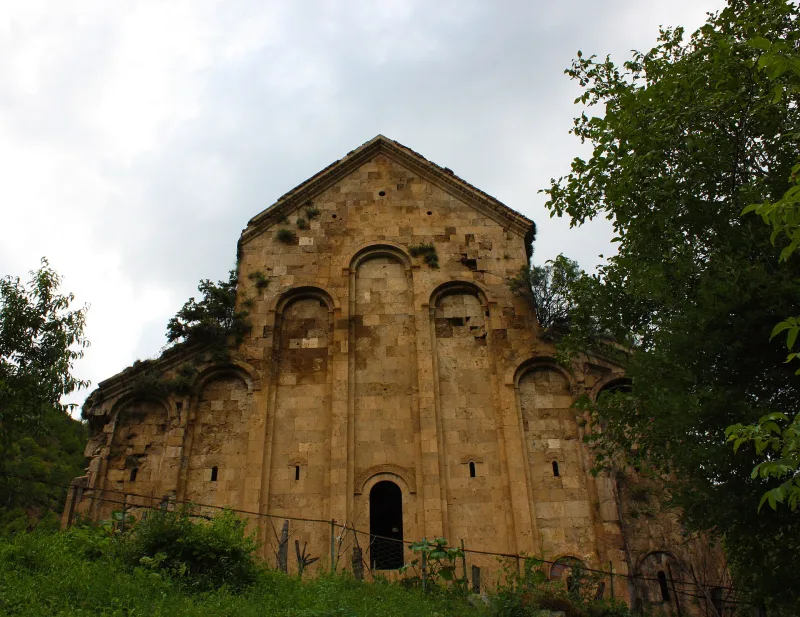
The Otkhta Eklisia Cathedral is a monumental three-nave basilica with a gabled roof and a distinctive façade adorned with carved arches and pilasters. The building is approximately 30 meters long, 18 meters wide, and the vault rises to nearly 20 meters. The walls are built of carefully dressed blocks of yellow sandstone, featuring stone carvings that are partially preserved on the facades and portals. Unlike the domed churches of Oshki and Ishkhani, Otkhta Eklisia belongs to a type of basilica church rare for the region, which links it to early Christian examples from Syria and Byzantium.
The Main Cathedral
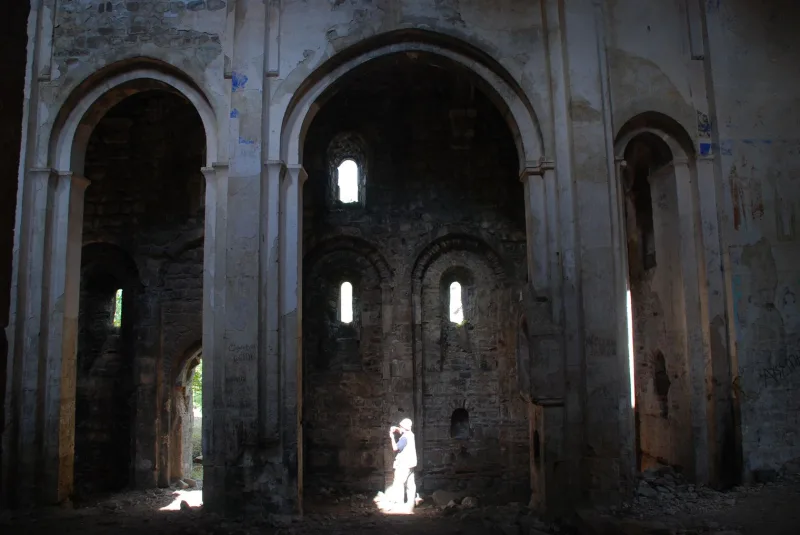
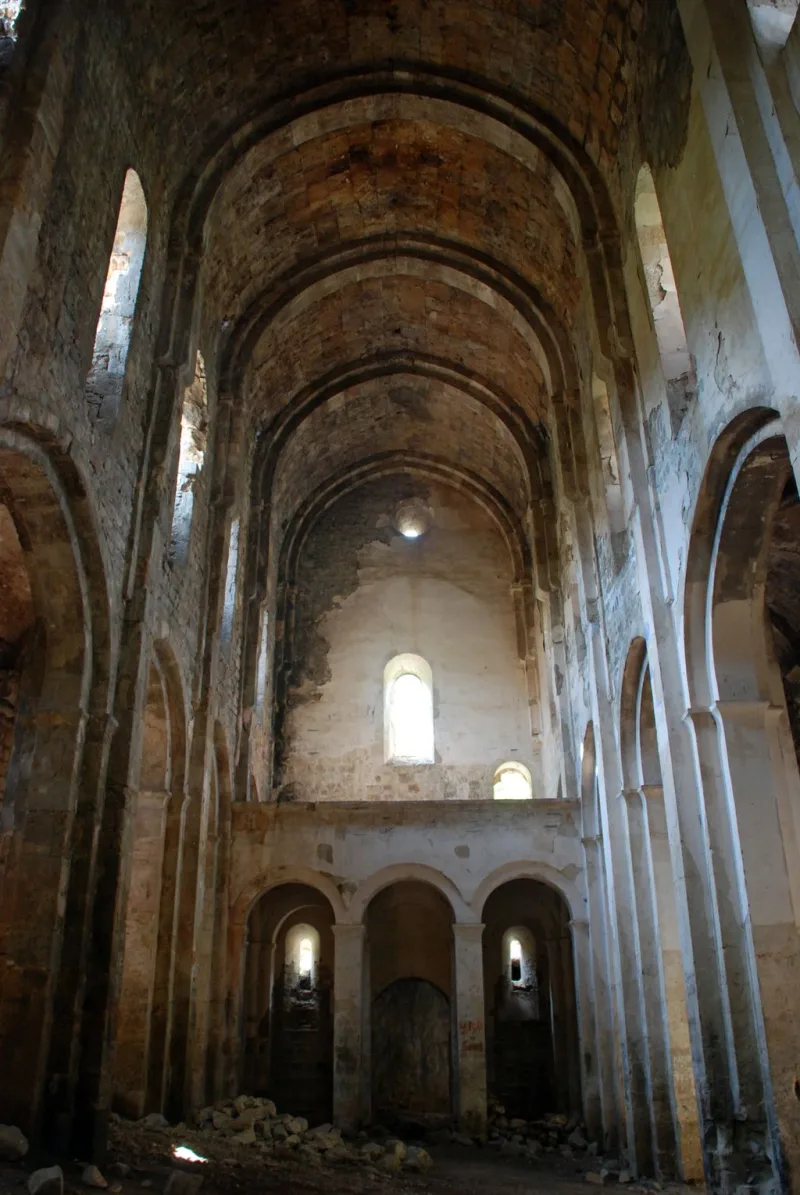
Inside, the church impresses with its vast space. The side aisles are separated from the central nave by two rows of massive columns supporting a system of arches. The vaulted ceiling of the central nave is higher than those of the side aisles, creating an upward-reaching effect and emphasizing the solemnity of the space. Fragments of 11th–12th-century frescoes depicting saints, apostles, and Gospel scenes have been preserved on the walls. In the apse, the silhouettes of the Deesis—Christ, the Virgin Mary, and John the Baptist, facing one another in prayerful dialogue—are clearly visible.
Carved Decor
The cathedral’s facades are adorned with decorative elements characteristic of 10th-century Georgian architecture: relief arches, grapevines, crosses in medallions, and symbolic depictions of animals. Above the western portal, a carved composition depicting an eagle holding an animal in its talons has been preserved—likely a symbol of the victory of heavenly forces over earthly ones. On the southern facade, Georgian inscriptions in Asamtavruli script bearing the names of the donors and construction dates are visible, though many of them have been heavily eroded by time.
Surrounding Structures
In addition to the cathedral, the ruins of three small churches—northern, southern, and eastern—have survived on the monastery grounds. They are compact single-nave structures with apses, in which altar niches and fragments of decorative carvings are still discernible. Only the foundations and fragments of walls remain of the residential cells, the refectory, and the service buildings. The surrounding landscape—steep slopes covered in dense forest and a distant view of the Chorukhi River—remains one of the most beautiful aspects of the visit.
Interesting Facts and Legends
- The name “Dörtkilise” (Turkish for “Four Churches”) precisely mirrors the meaning of the Georgian “Otkhta Eklisia”—an example of rare toponymic continuity following a population shift.
- The main cathedral is one of the largest three-nave basilicas of the Georgian architectural school of the 10th–11th centuries.
- The carved eagle on the western portal is one of the monument’s most recognizable symbols, frequently reproduced in books on medieval Georgian art.
- In the 19th century, Ekvtime Takaishvili described unique inscriptions on the temple wall, some of which were subsequently lost.
- For a long time, local residents referred to the ruins as “Eski Kilise”—“Old Churches.”
- Unlike the neighboring towns of Oshki and Khakhuli, Otkhta Eklisia was not converted into a mosque, which has partly preserved its authentic appearance.
- Researchers note the similarity of the church’s layout to 6th-century Syrian basilica churches, suggesting possible cultural contacts via Armenia and Byzantium.
How to get there
Otkhta Eklisia is located in the village of Tekozdjan (former Georgian name — Otkhta or Dörtkilise) in the Yusufeli district of Artvin Province. The distance from the town of Yusufeli to the monastery is about 8 kilometers; the drive takes approximately 20–25 minutes by car. The distance from Artvin is about 80 kilometers, and from Erzurum—about 200. The most convenient option is to rent a car in Artvin or Erzurum and plan a route through the Chorukhi River valley.
Visiting is possible without a car: from Yusufeli, you can take a local taxi to the village of Tekezjan, then walk about a kilometer along a dirt road to the ruins themselves. Many tourists combine a visit to Otkha Eklesia with a visit to Parhali (Barahl), which is located in the same valley. Also nearby is the famous Yusufeli Dam on the Chorukhi River, which has transformed the local landscape and relocated some historic villages to new sites.
Tips for Travelers
The best time to visit is late spring (May–June) and fall (September–October), when the sun is mild and the Chorokhi River valley is painted in picturesque shades of green and gold. In summer, it gets hot in Yusufeli (up to 35 degrees Celsius), but the mountain valleys remain pleasantly cool. In winter, the road to the monastery can sometimes become impassable due to snow and landslides. Bring comfortable shoes, water, a flashlight, and a wide-angle lens for photography.
Respect the sanctity of the place: although Otkhta Eklisia is no longer an active church today, it remains an ancient Orthodox shrine, and many Georgian pilgrims come here specifically to pray. Do not leave trash behind, do not write on the walls, and do not chip away pieces of stone. If you are interested in Georgian church architecture, read the monographs by Vakhtang Beridze or guidebooks on Tao-Klarjeti in advance.
Within a 30–60-kilometer radius of Otkhta Eklisia are other outstanding Georgian monuments: Parkhali (Barakhli)—the largest basilica in the region; Oshki—a gigantic domed cathedral; Ishkhani—a cathedral with unique frescoes; Doliskana—a church with a fully preserved facade decoration. Combining these sites into a three- or four-day itinerary will provide a comprehensive overview of the pinnacles of medieval Georgian architecture. Otkhta Eklisia is a must-see on such a journey and one of the places where the connection between landscape, history, and spiritual memory is felt most acutely.
Current Condition and Protection of the Monument
Today, Otkhta Eklisia is included in Turkey’s list of cultural heritage sites and is formally under state protection. However, actual protective measures are minimal: the site is not fenced off, there is no permanent caretaker, and there are no informational signs for visitors. In the 2010s, with the participation of Turkish and Georgian specialists, initial work was carried out to survey and photograph the monument, and a conservation project was developed, but a full-scale restoration has not yet been implemented. The main risks include erosion of the masonry, collapse of the vault, and deterioration of the frescoes due to moisture and temperature fluctuations.
Public interest plays a significant role in preserving the monument. Every visitor who shares photos and impressions on social media increases the visibility of Otkhta Eklisia in the international cultural sphere. The Georgian Church and civil society organizations also play an important role by organizing pilgrimages and academic conferences dedicated to the heritage of Tao-Klarjeti. As tourist traffic to Yusufeli grows—especially in connection with new hydropower and infrastructure projects—it is highly likely that the monastery will receive more attention from security services. Those planning a trip are advised to check the current condition of the access road, especially after heavy rains or spring floods.
Otkhta Eklisia is one of the most mysterious monuments of Georgian culture on Turkish soil, and every visit to this monastery leaves one with the feeling of having touched a vast, partially lost, yet still living world of medieval Georgia. The area around the ancient basilica preserves the very silence that medieval monks sought—a silence in which the sound of stone, the wind, and the distant murmur of the Chorokhi River ring out particularly clearly.
Liturgical and Cultural Context
In the medieval Georgian tradition, the monasteries of Tao-Klarjeti formed a unified network linked by common liturgical practices, a hymnographic repertoire, and an iconographic canon. Otkhta Eklisia was not an isolated monument—its charter, scribal traditions, and artistic models were harmonized with those of Khanzta, Shatberdi, Opiza, and other centers in the region. Monks served and worked here, whose names have been preserved in the inscriptions and colophons of manuscripts. Among them are mentioned translators, scribes, and icon painters, representing the high level of literary and artistic culture for which the Georgian Church of the 10th–11th centuries was renowned.
Through the Tao-Klarjeti monastic network, the Georgian spiritual and intellectual tradition maintained a constant exchange of ideas with Byzantium, Mount Athos, Jerusalem, and Syria. At Otkhta Eklisia, texts translated from Greek and Arabic were copied, and original hymns and sermons were composed, which were then disseminated throughout the Christian Caucasus. This makes the monastery not only an architectural monument but also a crossroads of cultural currents that left a deep mark on the history of Eastern Georgia and neighboring lands. Understanding this context helps us see the stone basilica not merely as ruins, but as a living hub of a multi-layered medieval reality.
Equally important is that Otkhta Eklisia reflects the practical experience of monastic life at that time. The monks’ lives were organized around the daily cycle of worship: Matins, Liturgy, Vespers, and Compline were followed by hours of handicrafts and book copying. In the refectory, the lives of the saints were read; in the cells, prayers were offered according to the rule of Saint Savva the Sanctified. Therefore, every stone of the monastery bears traces of this daily rhythm, and a thoughtful visitor, pausing at the western portal or in the side aisle, seems to hear the echo of voices long since silenced. It is precisely this richness of memory that is the main thing distinguishing Otkhta Eklisia from an ordinary tourist attraction.